
Dental veneers for worn teeth can restore lost shape while also correcting chips, uneven edges, and persistent discoloration. Each veneer is individually designed and bonded to the visible surface of a tooth.
Before recommending veneers, the dentist must identify why the teeth have become worn, damaged, or discolored. Successful treatment depends on correcting the underlying problem as well as improving the visible appearance.
Dental veneers are thin layers of ceramic or tooth-colored composite material placed over the front surface of teeth. They are primarily used on visible front teeth to modify shape, length, color, and symmetry.
A veneer does not cover the entire tooth in the way a dental crown does. Its purpose is to provide a controlled aesthetic change while preserving as much healthy tooth structure as the case allows.
Our general dentistry and dental aesthetics service provides additional information about veneers, professional whitening, aesthetic fillings, and restorative dental care.
Worn, chipped, and discolored teeth may appear similar from a cosmetic perspective, but they can have very different causes. A veneer should not be used to conceal active dental disease or an unresolved bite problem.
A complete assessment considers:
When the underlying cause is left untreated, new veneers may be exposed to the same forces that damaged the natural teeth. Functional diagnosis is therefore an essential part of aesthetic planning.
Dental wear can make teeth look shorter, flatter, or uneven around the edges. It may develop because of grinding, clenching, an unbalanced bite, enamel erosion, or a combination of factors.
Veneers can rebuild the visible length and contours of teeth when the wear is mainly limited to their front surfaces. There must also be enough healthy structure to support reliable bonding.
The new length cannot be designed from appearance alone. The dentist must check whether the restored edges will interfere with speaking, chewing, or movements of the lower jaw.
Patients who grind or clench their teeth may need bite management and a protective night guard. Without controlling these forces, both natural teeth and restorations can remain vulnerable to chipping.
Advanced wear affecting many teeth may require a broader restorative plan. In these cases, veneers might form one part of treatment rather than being the complete solution.
A small chip can change the outline and symmetry of a front tooth even when it causes no pain. A veneer can cover the affected surface, replace the missing contour, and blend the tooth with its neighbors.
Not every chip requires a veneer. Minor edge damage may be repaired more conservatively with composite bonding, which adds tooth-colored material only where it is needed.
Read our guide to cosmetic dental bonding for minor chips and gaps to see when direct composite treatment may be appropriate.
A larger fracture requires a more detailed examination. The dentist must determine whether the crack extends deeper into the tooth, whether the nerve has been affected, and whether enough stable structure remains.
When much of the tooth has been lost, a crown may provide more complete coverage than a veneer. Root canal treatment or internal reconstruction may also be required when the damage is not purely cosmetic.
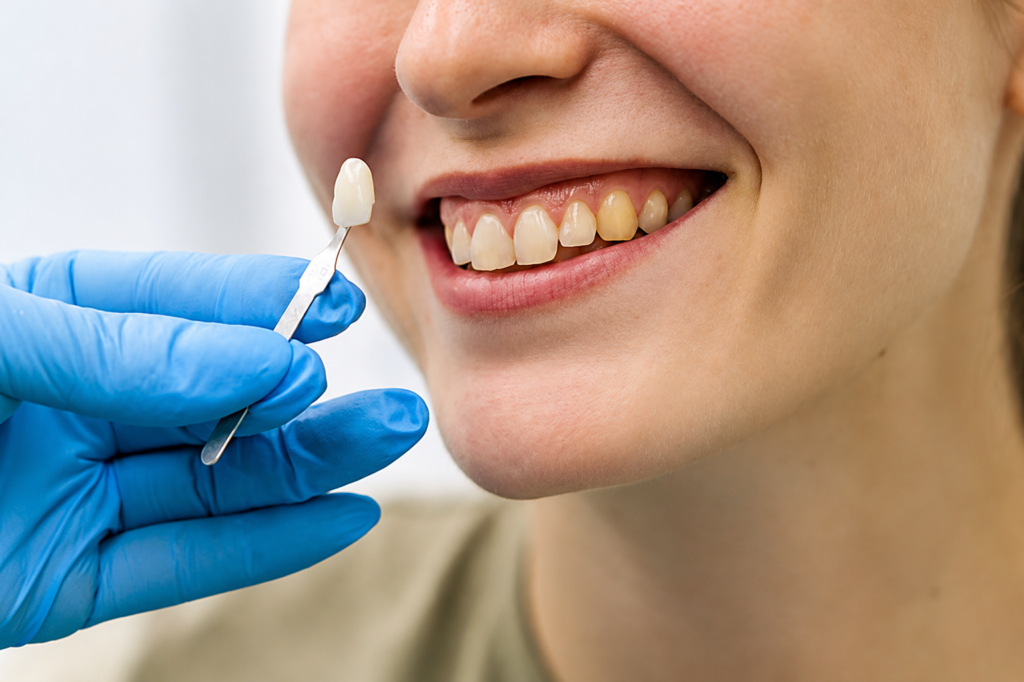
Surface stains caused by food, drinks, or plaque can often be treated with professional cleaning or whitening. Veneers should not automatically be the first treatment for every tooth-color concern.
Our guide to teeth whitening in Albania explains how professional whitening differs from restorative treatments.
Veneers become more relevant when discoloration is internal, severe, uneven, or resistant to whitening. They may also be considered when the color problem appears together with worn enamel, irregular shape, or small areas of damage.
The chosen ceramic must have the correct balance of translucency and masking ability. Material that is too translucent may allow a dark underlying tooth to remain visible, while an overly opaque veneer can look flat or artificial.
Color planning should include the surrounding natural teeth. If whitening is part of the treatment plan, it is normally completed before the final veneer shade is selected because restorative materials do not whiten like natural enamel.
Veneers require healthy supporting teeth and gums. They are not designed to cover untreated decay, infection, or active periodontal disease.
Another treatment may be needed first when the patient has:
When alignment is the main concern, orthodontic treatment may provide a more appropriate correction. Veneers can disguise limited irregularities, but they should not replace necessary tooth movement.
Composite and porcelain veneers can both improve worn, chipped, or discolored teeth. Their production, appearance, maintenance, and clinical uses are different.
Factor | Composite veneers | Porcelain veneers |
Production | Sculpted directly on the tooth | Custom-made in a dental laboratory |
Treatment time | Often completed in one appointment | Usually includes a laboratory stage |
Stain resistance | More likely to lose polish or absorb stains | Generally more resistant to discoloration |
Repair | Can often be repaired directly | Significant damage may require replacement |
Appearance | Suitable for moderate corrections | Provides enamel-like translucency and surface detail |
Common use | Small chips and localized changes | More comprehensive shape and color correction |
Our detailed comparison of composite and porcelain veneers examines the main differences in aesthetics, durability, and maintenance.
E-Max lithium-disilicate ceramic is one option for laboratory-made veneers. It combines strength with optical properties that can reproduce the depth and translucency of natural enamel. Learn more about the benefits of choosing E-Max veneers.
The most expensive or strongest material is not automatically the best choice for every tooth. Material selection should reflect enamel condition, tooth color, bite forces, treatment goals, and the amount of change required.
Planning begins with an examination of the teeth, gums, and bite. Clinical photographs and appropriate X-rays help the dentist identify structural problems that may not be visible from the front.
The dentist then evaluates tooth length, the smile line, gum exposure, facial proportions, and the relationship between neighboring teeth. This determines whether treatment should involve one tooth, a small group, or a wider visible area.
The desired outcome should be discussed before any tooth preparation. Some patients need only a small repair, while others want a coordinated change in length, shape, and color.
A preview or proposed design may be used to evaluate proportions before the final veneers are produced. This stage is important because correcting a tooth on a computer or model is easier than modifying bonded ceramic later.
Once the plan is approved, the teeth are prepared according to the requirements of the case. Some veneers need very limited preparation, while others require controlled enamel reduction to create space and avoid an overcontoured result.
An impression or digital scan records the prepared teeth and surrounding structures. The dental laboratory uses this information to create the required shape, shade, texture, and translucency.
City Dental Clinic works with the Perfect Dent 4.0 dental laboratory, which uses CAD/CAM systems and works with materials including lithium disilicate and zirconia.
Temporary restorations may be used when preparation has been performed and the final veneers are being manufactured. They allow the dentist and patient to evaluate provisional shape and function.
Before final bonding, each veneer is checked for fit, color, contact with neighboring teeth, gum relationship, and bite. Adjustments are completed before the bonding procedure is finalized.
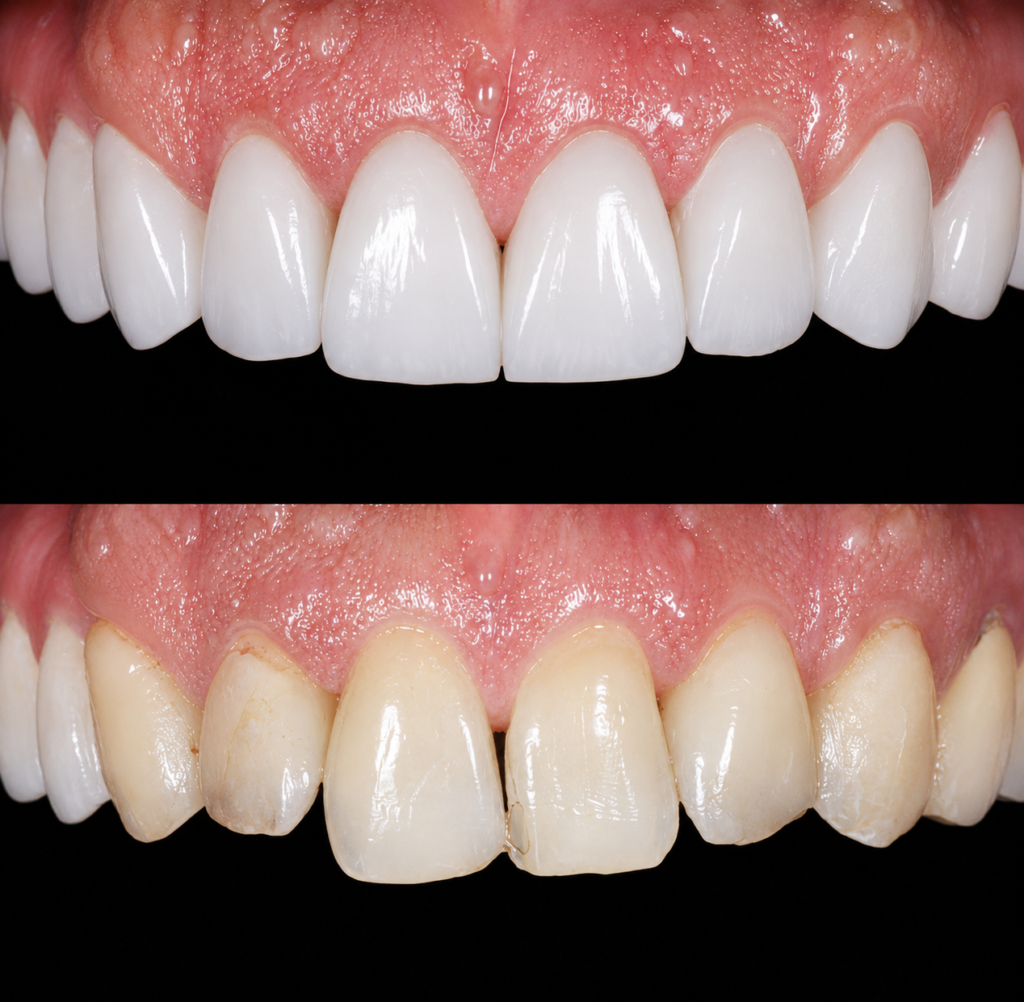
A natural result is not defined only by having whiter teeth. Tooth proportions, edge shape, surface texture, translucency, and the way light passes through the material are equally important.
Teeth should not appear identical or excessively uniform. Subtle differences in form and surface character help restorations blend with the patient’s natural dentition.
Veneer shape must also be compatible with speech and bite function. An attractive design that creates heavy contact or feels uncomfortable during jaw movement is not a successful result.
You can view clinical cases from City Dental Clinic to see why each treatment must be designed around the individual patient rather than a standard veneer template.
Veneers require the same daily oral hygiene as natural teeth. Brushing, interdental cleaning, and regular professional examinations protect the supporting teeth and gums.
Patients should avoid biting ice, pens, fingernails, packaging, or other hard objects. Ceramic and composite are designed for normal dental function, not for habits that could also damage natural enamel.
If grinding is present, the dentist may recommend a protective appliance. Bite changes, gum inflammation, sensitivity, or a loose restoration should be examined rather than ignored.
Read our complete guide to the care and maintenance of dental veneers for further aftercare information.
The most conservative treatment that can produce a stable result is usually preferred. The correct option depends on the amount of damage and the cause of the problem.
Patients considering several options can also read our overview of aesthetic treatments for improving tooth shape and color.
Yes, veneers can restore some lost tooth length when adequate healthy structure remains. The proposed length must be tested against the patient’s bite and jaw movements.
A veneer may be appropriate for a stable tooth with moderate visible damage. A very small chip may need only bonding, while extensive damage may require a crown.
Veneers cover discoloration rather than removing pigment from inside the tooth. The cause of the color change should be diagnosed before deciding between whitening and restorative treatment.
Not to the same degree. Preparation depends on the position, shape, color, and material involved, but patients should understand that treatment becomes irreversible when enamel is removed.
Clinical measures are used to keep the patient comfortable throughout treatment. Temporary sensitivity can occur, but persistent pain should be assessed by the dentist.
Porcelain veneers are generally more stain-resistant than composite. Natural teeth, bonding margins, and surrounding restorations can still change in appearance over time.
Longevity depends on the material, bonding quality, bite, hygiene, and patient habits. Regular examinations can identify minor issues before they become larger problems.
Yes. A damaged, worn, or unsuitable veneer can be replaced after the underlying tooth and surrounding gum have been examined.
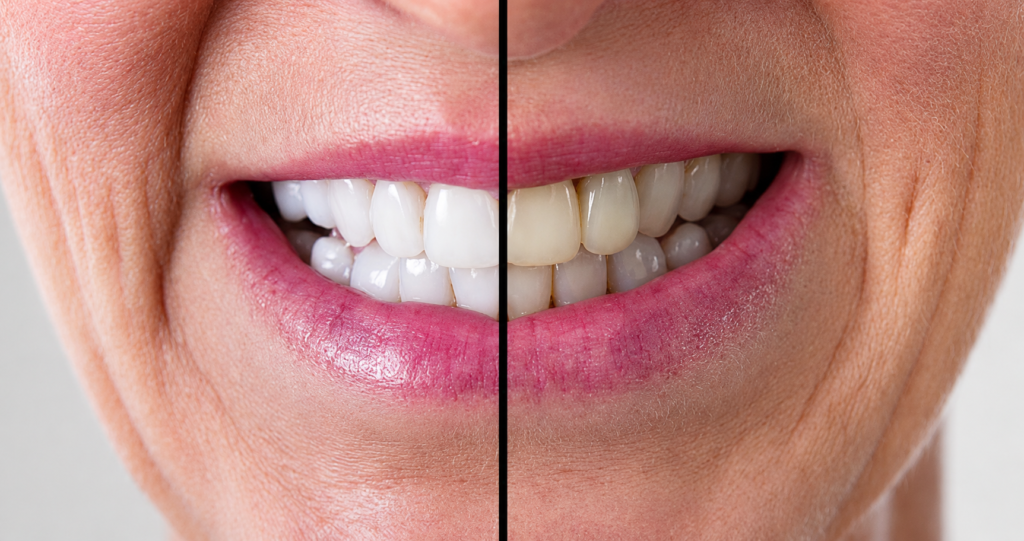
If you have worn, chipped, or discolored teeth, the first step is determining which treatment will preserve the greatest amount of healthy tooth structure. At City Dental Clinic, veneer planning includes an assessment of the teeth, gums, bite, existing enamel, and desired result.
Your consultation can include:
Contact City Dental Clinic at +355 68 510 7070, email info@cdc.com.al, or visit us at Rruga “Siri Kodra,” Building No. 13, Entrance No. 1, Tirana, Albania.

