
If you have ever heard of dental implants, you most likely have heard that they come in two types, which are subperiosteal and endosteal. Since endosteal ones are used in most cases, more people are familiar with them.
As the name states, endosteal implants are inserted in the jawbone and serve as a replacement for the root. Endosteal implants come in a variety of forms and are further divided into subtypes based on dimensions, form, and attachments. On the other hand, subperiosteal implants are positioned above the jawbone but beneath the gums.
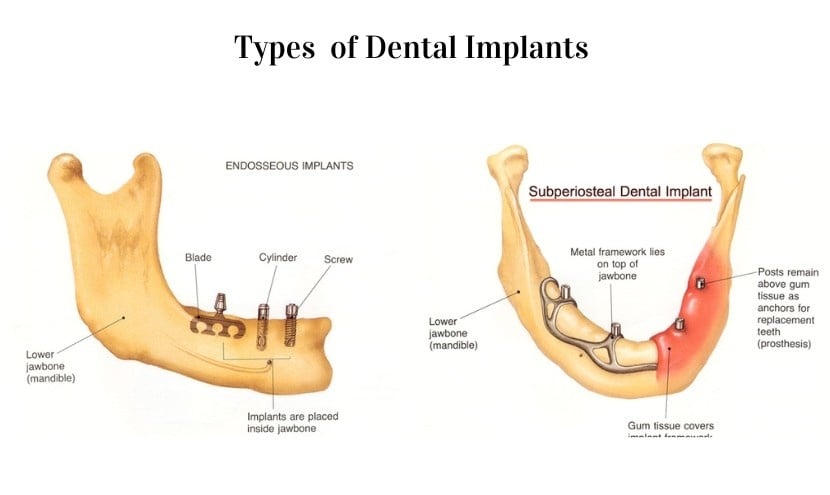
Usually, endosteal implants are made up of three parts: the implant, the abutment, and the prosthetic teeth. Usually, the implants look like screws and are composed of titanium. This material offers a strong base that is biocompatible, reducing the risk of rejection. However, sometimes, they can also be composed of ceramic.
Another important component of the endosteal implants is the abutment, which serves as a connector between the implant and the artificial tooth. After the healing process of the implant is over, the dentist will place the abutment on top. Endosteal implants will be great for replacing several missing teeth as they can support a dental crown bridge and denture.
On the other hand, the composition and structure of subperiosteal implants differ from endosteal implants since they are not surgically placed into the bone. During this procedure, the screw will be replaced with a metal frame that will fit over the jawbone and beneath the gums. Further on, we will explain the structure of subperiosteal implants in more detail if you are interested.
As we mentioned, the subperiosteal implants are made of a metal, titanium framework, and prosthetic teeth that are already attached. This framework is specially designed to fit the patient’s jawbone perfectly and once it is placed it will sit there comfortably without causing any issues.
Due to the recent advancements in the implantology field, the metal framework will be designed using the best technology in order to fit your mouth perfectly. This precise fit will make sure that it mimics the natural shape and structure of your teeth and you won’t notice any difference. The metal structure will also be titanium since it provides a strong base and durability and is very compatible with the body.
As we mentioned before, prosthetic teeth will already be attached to the framework, which will make the process faster. These prosthetic teeth will be designed perfectly to match the patient’s natural teeth color, shape, and size. They will not differ from your natural teeth and will also function the same.
Subperiosteal implants will work great for patients who suffer from insufficient bone density or height. After they are placed they provide a stable foundation for the new teeth and will function and look the same as your natural ones.

When it comes to the placement procedure of endosteal implants, it is important to consult a specialized implantologist. After they do a thorough check-up, they will decide if you are a suitable candidate for either of the treatments. During the initial consultation, feel free to ask your surgeon any questions you might have, including the price and the recovery timeline.
Once you are considered a suitable candidate for an endosteal implant procedure, during the day of the surgery the oral surgeon will numb the area and will cut your gum to make the jawbone visible. After this step is done he will drill holes in the bone to make it ready for the placement of the implant. After the implant is placed the surgeon will make some incisions that will most likely fall on their own.
During the first day after the procedure, it is normal to experience some level of swelling, bruising, discomfort, and bleeding that is usually located in the face and gums. The surgeon will give you the proper instructions on how to take care of your mouth and will also prescribe antibiotics and pain medication to manage any type of discomfort. Also, keep in mind to eat soft foods until you are ready to return to your regular diet.
The osseointegration process is known as one of the most important steps of the implant procedure. During this time the jawbone will grow into the implant and act as a solid base for the new artificial tooth or several teeth.
Once the implant placement and the osseointegration are done, you will enter the other stage which is the abutment placement. This entails the opening of the gum and the placement of the abutment on top.
The abutment will serve as a connector between the implant and the prosthetic teeth. Sometimes, the abutment placement will be already attached to the implant so you will not need to return to the dental office several times for this step. The choice between these two choices will need to be made with the help of your surgeon based on your needs.
After two weeks have passed since the abutment has been placed and your gums have perfectly healed, the dentist will get to work to make a proper impression of the crowns. Depending on your preference, you can choose between a fixed or removable artificial tooth.

During the preparation for subperiosteal implants, the dentist will start by making a thorough examination of the patient’s mouth which includes performing X-rays or CT scans. This will allow them to evaluate if your bone structure is capable of maintaining the subperiosteal implants.
In order to make the prosthetic teeth fit your mouth it is important to make a perfect impression of your jawbone. This impression will allow the implant to fit better into the patient’s jaw and avoid any pain or discomfort.
To guarantee the patient’s comfort, local anesthesia or sedatives are the first steps that are administered before the surgery. To reveal the jawbone beneath the gum tissue, the dentist creates an incision in the tissue.
The periosteum—the layer of tissue covering the bone—and the mandible are covered by the specifically made metal framework of the subperiosteal implant. The posts or bars of the implant framework are not covered by the gum tissue when the gums are sewn back over them.
After the first step is done, the gums will need some time to recover. This will allow the framework to properly integrate with the surrounding tissues of the mouth, making it a stable base for the artificial teeth.
After the subperiosteal implant has healed and been firmly fixed, the implant framework’s posts or bars are used to connect prosthetic teeth, such as crowns, bridges, or dentures. The dentist makes any required changes to guarantee that the prosthesis fits comfortably and correctly.
Follow-up appointments are planned on a regular basis to keep an eye on the healing process, make sure the implant is integrated correctly, and maintain good dental hygiene. Subperiosteal implants require good oral hygiene and routine dental examinations to be successful and long-lasting.

Endosteal implants are known for their enhanced stability and their ability to provide a strong base for new prosthetic replacement teeth. Since they are directly implemented on the jawbone they will mimic the function of the root perfectly. After the procedure, you will be able to eat, speak, and chew your food without worrying about breaking them.
When you miss a tooth or several of them, your oral health will be greatly impacted in the short and long term. When it comes to long-term damage, if you dont find a way to replace your teeth, they will eventually move toward each other in order to fill the gap. If this happens, the whole structure of your face will change. Endosteal implants will be the best way to stop this from happening.
Since endosteal implants are made of titanium which is a biocompatible material they will last for a very long time and offer long-term solutions. Titanium also works great since it integrates well with the body without causing any rejection issues.
Once you replace missing teeth and avoid the movement of your teeth and jaw, you will feel more confident and comfortable with your new teeth. They offer the best choice among others since they don’t move around and replace the whole missing structure of your teeth.
Another huge benefit of endosteal implants is that there is no need to adjust or to alter the teeth located nearby. This is a huge benefit and improvement and it will make it easier for you to maintain your overall dental health.
Subperiosteal dental implants are the perfect choice for patients who have suffered from bone loss. Because some individuals do not have enough height on their jaw for traditional implants, they will be perfect since they are declined to rest on the jawbone and under the gum. They are mostly preferred since they avoid the need for complex and painful procedures like bone grafting.
Subperiosteal implants will not need more than two dental visits, as opposed to standard implants that need many months to fuse with the bone. Treatment time is shortened considerably since the first step will be the impression, and the other one will be the placement of the implant.
Since they will be placed in only two visits they will also function immediately. You won’t have any difficulty while eating or drinking, but however we advise you to take it slow in order to get used to this new feeling.
Just like endosteal implants, subperiosteal ones will work great in preserving the bone structure since they are positioned above the jawbone. This occurs as a result of the pressure that food puts on the implants during chewing, which transfers to the bone and encourages bone formation.

One of the main differences between endosteal and subperiosteal implants is their placement. While endosteal implants are placed directly to the jawbone, subperiosteal ones are placed on or above it but under the gum.
With endosteal implants, you will need more than one surgery. One is needed to connect the implant to the bone and the other will connect the implant and the artificial teeth, with the help of an abutment. After a long waiting period, the surgeon will be ready to attach the new teeth. Once it is displaced and healed it will work the same as your natural teeth, providing durability and maintaining position.
Usually, the patient will need subperiosteal implants if they have suffered from bone loss and they are not suitable for traditional endosteal implants. They will work perfectly in these cases and offer great stability.
Because endosteal implants must be surgically inserted into the jawbone, the process is more complicated. This typically requires many appointments in addition to a healing period between the implantation of the implant and the attachment of the prosthetic tooth.
On the other hand, subperiosteal implants are less invasive, as they are placed above the jawbone. Patients who want to avoid the more intrusive surgery needed for endosteal implants are frequently better suited for them.
Endosteal implant recovery times might vary from case to case, although they usually take several months. This covers the duration of the implant’s surgical implantation as well as the healing period needed for the surrounding bone to develop and maintain the implant.
On the other hand, when subperiosteal implants are placed on top of the bone, they generally require a shorter recovery period. However, a variety of factors, including the patient’s general health, the quantity of implants, and following the postoperative care recommendations, might affect the final recovery period.
Patients who have enough density in their bones, good oral and general health, and tooth loss are appropriate candidates for endosteal implants. They work well for the majority of patients and are the most often recommended kind of implant for most patients.
On the contrary, individuals who are unable to wear traditional dentures, have insufficient bone height in their jaw or do not wish to undergo bone grafting procedures performed in order to repair the bone are the ideal candidates for subperiosteal implants. For people who would not be able to get an endosteal implant otherwise, subperiosteal implants provide an excellent alternative.
Similar to the roots of natural teeth, endosteal implants support and encourage bone formation. This can maintain face structure by preventing the loss of jaw bone, which will happen if the tooth is not replaced.
On the other hand, subperiosteal implants do not directly touch the jawbone and do not offer the same degree of bone preservation. As a result, individuals who have had a severe loss of jaw bone may not find them very useful.
Endosteal implants are placed into the jawbone to resemble a natural tooth’s root. They have a cylindrical or screw-like shape. The most popular material for them is titanium since it fits the body perfectly without causing any rejection issues and is lightweight.
Additionally, a metal structure is positioned on or above the jawbone but beneath the gum line in subperiosteal implants. Compared to endosteal implants, this design is often bigger and more complex.

